Emergency Contact List Template for Your Family
An emergency contact list holds every number your family needs in a crisis: household members, an out-of-area contact, doctors, schools, utilities and insurance. Keep it on paper and on phones.
An emergency contact list is one page with every phone number your household might need in a crisis: each other, an out-of-area contact, schools, doctors, utilities and insurance. It matters because phones die, get lost or stop working in a disaster, and very few of us know more than a couple of numbers by heart.
Below is a simple template you can copy, with notes on what to include, why an out-of-area contact works, and how to put the list where it will actually help: on the fridge, in backpacks and on every phone. You can also fill it in with the free family emergency plan template, which builds a printable contact page for you.
Why you need a written contact list
During an emergency, the numbers stored in your phone are only useful if your phone works and is with you. If a child’s phone is dead at school, or a grandparent’s phone is left behind during an evacuation, they need another way to reach you.
The American Red Cross recommends that everyone carry emergency contact information in writing as well as saved on their cell phones. It also recommends giving these numbers to places where your children spend time, like school and daycare. A paper list is the backup that works when nothing else does.
The emergency contact list template
Copy these sections onto a single page. Fill in names, relationships and at least two phone numbers per person where possible.
1. Household members
For each person in your home:
- Full name and date of birth
- Cell phone number
- Work or school name, address and main phone number
- Any medical conditions or allergies first responders should know about
2. Out-of-area contact
- Name and relationship
- Cell and home phone
- Email address
- City and state (so everyone knows which region they are in)
3. Local backup contact
A neighbor, friend or relative nearby who can check on your home, pick up a child, or care for a pet if you cannot get there. Ideally someone with a spare key.
4. Schools and childcare
- School or daycare name, main office number and address
- The school’s emergency notification method (text, app, email)
- Names of every person authorized to pick up your child
5. Medical contacts
- Primary care doctor and any specialists
- Pharmacy name, phone number and address
- Health insurance company and member numbers
- Veterinarian and nearest 24-hour animal hospital
6. Utilities and services
- Electric company outage line
- Gas company emergency line
- Water utility
- Internet or phone provider
7. Insurance and property
- Homeowners or renters insurance company, policy number and claims phone
- Car insurance company and policy number
- Landlord or property manager, if you rent
8. Local emergency information
- 911 for emergencies
- Non-emergency police and fire department numbers
- County or city emergency management office
- Your home address with nearest cross streets, so a babysitter or visitor can give directions
- Your family meeting places (one right outside your home, one outside your neighborhood)
How the out-of-area contact works
The out-of-area contact is the single most useful idea in family emergency communication. The Red Cross explains that after a disaster it may be easier to call or text long distance when local phone lines are overloaded or out of service.
Here is how to set it up:
- Pick someone far enough away that the same storm, wildfire or earthquake is unlikely to affect them. A relative in another state is ideal.
- Ask them first. Make sure they agree to the role and will keep their phone on during an emergency.
- Give them your full contact list, so they can reach schools, workplaces and other family members on your behalf.
- Agree to text first. Short text messages often get through when calls fail, and they use less battery.
- Have everyone check in with that one person. They keep track of who is safe and where, and pass messages between family members who cannot reach each other directly.
Name a second out-of-area contact as a backup in case the first one cannot be reached.
Wallet cards for kids and family members
The Red Cross suggests making contact cards for the whole family in case you are separated. These are especially important for children, who may not have a phone or may not know your number by heart.
A good wallet card fits on an index card or a business card and includes:
- The child’s full name
- Two parent or guardian phone numbers
- The out-of-area contact’s name and number
- The family’s neighborhood meeting place
- Any allergies or medical conditions
Print it, laminate it or cover it in clear packing tape, and tuck it into a backpack pocket, lunchbox or wallet. Make one for older adults, babysitters and anyone who regularly cares for your kids too. Practice with young children: ask them where their card is and what they would do with it.
Set up ICE contacts on every phone
ICE stands for “in case of emergency.” It started as a habit of saving a contact under the name “ICE” so first responders could find it. Modern phones have a better option built in: emergency contacts and medical information that can be seen from the lock screen without your passcode.
- iPhone: Set up a Medical ID in the Health app, add emergency contacts and turn on the option to show it when locked.
- Android: Look for emergency information or emergency contacts under Safety and emergency in Settings. Menu names vary by manufacturer and software version.
Add at least two contacts, including your out-of-area contact. If anyone in your family has a serious allergy or condition, list it there too. Do this for every phone in the household, including kids’ phones and older relatives’ phones.
Keep a paper copy in the right places
Once your list is filled in, put copies where they will be found:
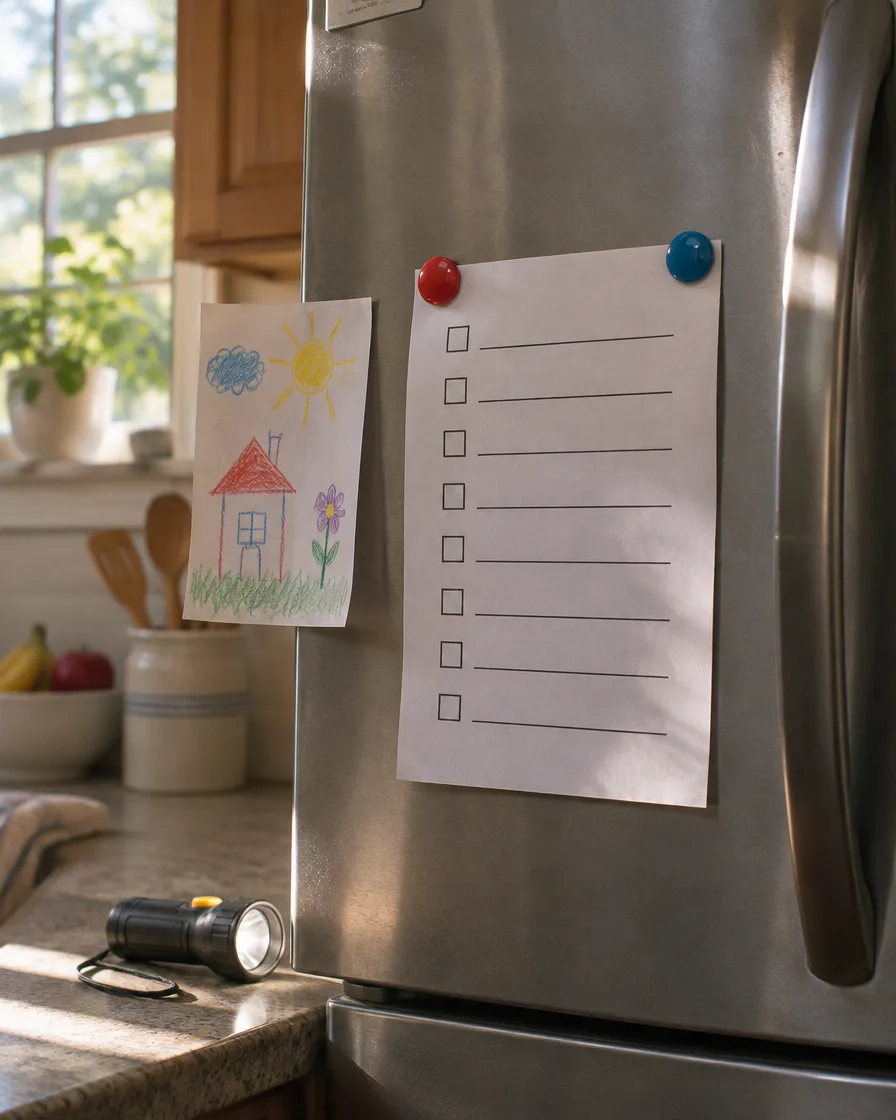
- On the fridge or inside a kitchen cabinet door, where babysitters and visitors can see it.
- In every go bag, in a waterproof bag with your other documents. See our go bag checklist for what else belongs there.
- In each car’s glove box.
- With your out-of-area contact.
- At school and daycare, on their emergency forms.
If you’d rather keep this on your phone too, ReadyHome stores your household contacts offline, so they are available without a signal.
Keep in mind that this list contains personal information. Store copies where they are useful to your family but not on public display outside your home.
Make it part of your family emergency plan
A contact list is one piece of a larger plan. Once it is done, use it to fill in the communication section of your family emergency plan, which also covers meeting places, evacuation routes and each person’s role. If you lose power, a printed list is often the only way to look up numbers, so read our power outage emergency plan for keeping phones charged.
Keep it current
An outdated contact list can be worse than none, because it sends people to numbers that no longer work. Review the list twice a year and update it immediately when:
- Someone gets a new phone number or email
- A child changes schools or a parent changes jobs
- You switch doctors, pharmacies or insurance companies
- Your out-of-area contact moves
When you update it, replace every copy: fridge, go bags, cars, wallet cards and your contact’s copy. Write the date at the top of the page so you can tell at a glance which version is current.
Emergency contact list checklist
Ticks are saved in this browser only.
Sources
- American Red Cross: Make a Plan
- Ready.gov: Make a Plan
- Ready.gov: Family Emergency Communication Plan (PDF)
- Ready.gov: Prepare Your Pets for Disasters
- American Red Cross: Survival Kit Supplies
Always follow instructions from your local emergency management office. Call 911 in a life-threatening emergency.